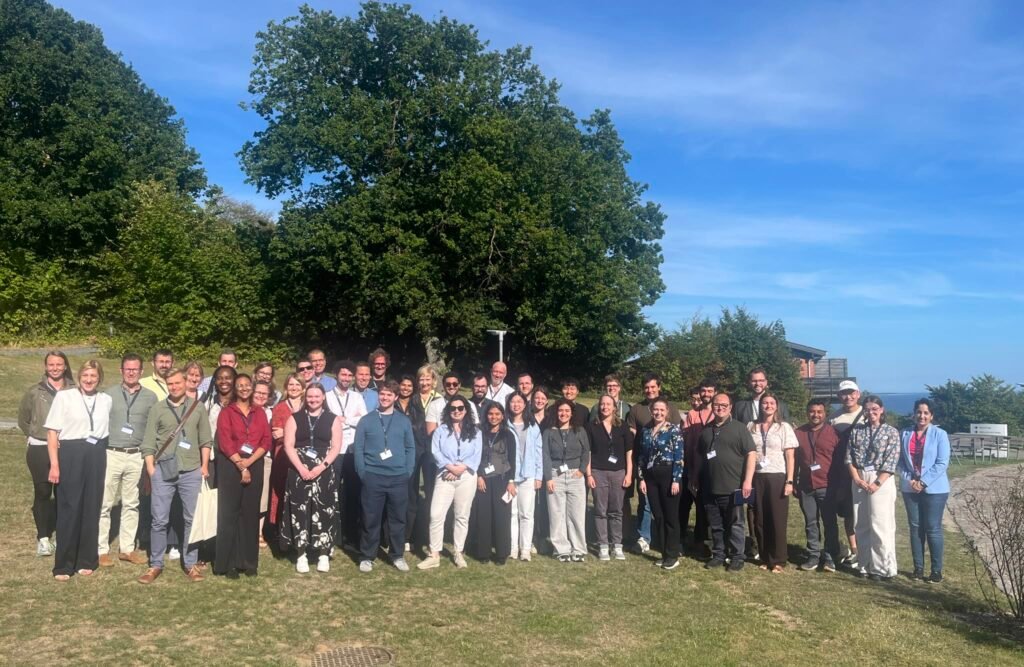
The participants of O-GlcNAc-NDD 2026 at Fuglsø, Denmark. Photo: Daan van Aalten.
From Aug 13 to 15, 2026, 55 scientists, clinicians, and parents met in Denmark for the O-GlcNAc Neurodevelopmental Disorders 2026 meeting (O-GlcNAc-NDD 2026). Prof. Daan van Aalten of Aarhus University organized the meeting together with Prof. Natasha Zachara of Johns Hopkins University.
At a glance
- The meeting had 8 sessions over 3 days, 25 posters, and talks by 3 families.
- The participants agreed to use one name for the disease: OGT-XLID.
- The experts want more natural history data, better animal models, and research on drugs that are already approved.
- Families can help most when they complete the research questionnaires and ask their clinicians to send data.
The meeting is about OGT-XLID and related disorders. These rare genetic conditions change how the body adds a sugar tag, O-GlcNAc, to proteins. The enzyme OGT adds this tag and the enzyme OGA removes it. When these enzymes do not work correctly, brain development can change.
About the meeting
- Dates: Aug 13 to 15, 2026.
- Location: Fuglsø conference center, Aarhus University, Denmark.
- Organizers: Prof. Daan van Aalten (Aarhus University) and Prof. Natasha Zachara (Johns Hopkins University).
- Participants: 55 scientists, clinicians, and parents from Europe and North America.
- Program: 8 sessions over 3 days (5 scientific sessions, 1 session about clinical perspectives, and 2 sessions for families), plus 25 posters.
Day 1 and Day 2 were for the scientific program. Day 3 was for families. On Day 3, the speakers discussed the research in simple language.
This was a closed meeting. A closed meeting lets researchers show data that is not yet published. For this reason, this report gives the titles of the talks and posters, but not the data. The Day 3 sessions were open to the community, and this report gives a summary of it.
Day 1: Aug 13
Day 1 had two sessions. Each scientific session had talks by senior researchers and one or two talks by early career researchers.
Session 1: Welcome and introduction to the field
Chair: Natasha Zachara
- Daan van Aalten, Aarhus University: Welcome, and DDX3X as a candidate conveyor of OGT-ID
- Lance Wells, Complex Carbohydrate Research Center, University of Georgia: O-GlcNAc Transferase Intellectual Disability Variants Alter Interaction with and Function of the SET1/COMPASS Complex
- Katrin Õunap, University of Tartu: OGT-ID and trajectories of other NDDs
- Iria Esperon Abril, Aarhus University, early career talk: OGT-ID mouse phenotypes and genetic rescue
Session 2: Dysregulation of O-GlcNAc in pathological models
Chair: Daan van Aalten
- Natasha Zachara, Johns Hopkins University: A Pathogenic TPR Domain Mutation in OGT Links Anxiety to Tissue-Specific O-GlcNAc Dysregulation and Interactome Remodeling
- Magdalena Krygier, Gdańsk, and Florence Authier, Aarhus University: O-GlcNAcase dosage variants are associated with neuronal deficits and intellectual disability
- Huijie Yuan, Aarhus University, early career talk: Screenable stem cell models of O-GlcNAc dyshomeostasis
Day 1 ended with the group photo, poster session 1, and dinner.
Day 2: Aug 14
Day 2 had four sessions, including the session about clinical perspectives.
Session 3: O-GlcNAc in development and pregnancy
Chair: Lance Wells
- Sam Myers, La Jolla Institute for Immunology: OGT as a major regulator of transposable element repression and early embryonic development
- Stephanie Olivier-Van Stichelen, Medical College of Wisconsin: O-GlcNAcylation Regulates Placental Growth Hormone Expression and Contributes to Sex-Specific Vulnerability in Gestational Diabetes
- Melina Brunelli, La Jolla Institute for Immunology, early career talk: Technical considerations for the confident characterization of OGT protein-protein interactions
- Eliane Schumacher, Medical College of Wisconsin, early career talk: Sex-Specific Regulation of Placental O-GlcNAc Transferase in Response to Oxidative Stress
Session 4: O-GlcNAc and neurobiology
Chair: Stephanie Olivier-Van Stichelen
- Olof Lagerlöf, Umeå University: The AMPA receptor as a common downstream mediator of OGT-ID
- Lilian Kisiswa, Aarhus University: OGT-ID is a synaptopathy with disrupted synaptic signaling/architecture and neuronal network activity
- Manish Bhattacharjee, Umeå University, early career talk: O-GlcNAc Transferase Regulates GABAergic Synapse Organization and Receptor Composition
Session 5: Clinical perspectives
Chair: Daan van Aalten
In this session, three families told the researchers about their life with OGT-XLID. A clinician from the UK National Health Service (NHS) gave the clinical view.
- Ivar Truss: Parent perspective
- Mel McSweeny, NHS, UK: Clinical perspective
- Sarah Lawson: Parent perspective
- Oliver and Rebecca Dinsch: Parent perspective
- Marie Sønderstrup-Jensen, Aarhus University, early career talk: OGT-ID natural histories and biomarkers
After the meeting, Daan van Aalten thanked the parents for their courage to attend and to present.
Session 6: Novel O-GlcNAc-dependent pathways
Chair: Sam Myers
- Benjamin Lauzier, Nantes Université: Unraveling Cardiac Development through O-GlcNAcylation: A new perspective
- Michael Boyce, Duke University: O-GlcNAcylation of the COPII coat protein Sec24D as a key regulator of secretory pathway function
- Janne Purhonen, Aarhus University and University of Helsinki, early career talk: Evolutionary-conserved temperature dependency leads to loss of protein O-GlcNAc in mammalian hypothermia
- Elisa Toscano, MaxWell Biosystems, sponsor talk: Advancing Functional Characterization of In-Vitro Neural Models with Next Generation Electrophysiology
Day 2 ended with poster session 2 and dinner.
Posters
Researchers showed 25 posters in two poster sessions, at the end of Day 1 and Day 2. Sarah Lawson and Steve Hill showed the CureOGT poster, “CureOGT: who, what and how”.
Show all 25 posters
- Sergio Galan Bartual: Structural analysis of OGA and its pathogenic variants
- Andrew Ferenbach and Narrayan Raam: A genetic approach to rapidly screen NDD variants
- Iria Esperon Abril: OGT-ID mouse phenotypes and genetic rescue
- Manish Bhattacharjee: O-GlcNAc Transferase Regulates GABAergic Synapse Organization and Receptor Composition
- Stephanie Olivier-Van Stichelen: Expanding the O-GlcNAc database
- Shagana Balasubramaniam and Conor Mitchell: DDX3X, a candidate conveyor of OGT-ID
- Biji Swain: Neuronal hyper-O-GlcNAcylation links synaptic and muscular dysfunction to progressive locomotor impairment
- Benedetta Attianese, Marie Sønderstrup-Jensen and Conor Mitchell: Dissection of an OGT-ID “hotspot” at Tyr180
- Janne Purhonen: Evolutionary-conserved temperature dependency leads to loss of protein O-GlcNAc in mammalian hypothermia
- Elisa Toscano: Advancing Functional Characterization of In-Vitro Neural Models with Next Generation Electrophysiology
- Marie Sønderstrup-Jensen: OGT-ID natural histories and biomarkers
- Manuel Peral-Vazquez: Population genetics and OGA-ID
- Melina Brunelli: Technical considerations for the confident characterization of OGT protein-protein interactions
- Jiawei Xu: Neuromuscular phenotypes in Drosophila models of OGT deficiency
- Gonzalo Payet: Dissecting Synapsin-1 O-GlcNAcylation
- Martin Bouaud: Unveiling the role of O-GlcNAcylation in cardiac development
- Chandni Kumar: Development of an antibody-independent O-GlcNAc enrichment matrix to study PTM crosstalk
- Akanksha Aggarwal: Inhibiting Hexosamine Biosynthetic Pathway Flux to Study the Impact of O-GlcNAc on Physiology
- Jingyu Pan: Environmental enrichment induces compartment-specific changes in hippocampal O-GlcNAc cycling
- Brycen Aldrich: Mechanisms of Neuronal O-GlcNAc Signaling: From Glycan Readers to WNK Kinases
- Kaizhou Yan and Xiping Chen: Mechanistic dissection of UAP1(L1)
- Xue Xia and Xiping Chen: Models and mechanisms of a first case of UAP1-CDG
- Alfonso D’Alessio and Huijie Yuan: An OGT Missense Variant associated with Hepatoblastoma
- Sarah Lawson and Steve Hill: CureOGT: who, what and how
- Eliane Schumacher: Sex-Specific Regulation of Placental O-GlcNAc Transferase in Response to Oxidative Stress
Day 3: Aug 15
Day 3 was for families. It had two sessions.
Session 7: Demystifying OGT-ID
This session was for parents. It started with short talks that explained OGT-ID in simple language. Then, five experts answered questions from the families:
- Natasha Zachara, Johns Hopkins University
- Lance Wells, University of Georgia
- Stephanie Olivier-Van Stichelen, Medical College of Wisconsin
- Katrin Õunap, University of Tartu
- Olof Lagerlöf, Umeå University
Steve Hill (CureOGT) opened the session. The families sent 19 questions before the session. Andrey Skripkin, founder of CureOGT, joined the session online. The next section gives the main points.
Session 8: Roadmap panel
After a coffee break, a second panel discussed a roadmap towards biomarkers and cures for OGT-ID. The meeting ended with lunch.
Highlights from the family Q&A
One name for the disease
Families hear many names for this condition: OGT-CDG, OGT-ID, OGT-XLID, OGT-NDD, and OMIM 106. The participants ranked these names in a live poll. OGT-XLID was first and OGT-NDD was second. The group agreed to use OGT-XLID from now on. One name makes communication clear. It can also help to get research funds.
Possible treatments
- OGA inhibitors. These drugs stop the enzyme that removes O-GlcNAc. In phase 1 trials for other diseases, people tolerated these drugs better than expected. But the dose must be adjusted carefully, because there is a possible risk to the heart. Also, some OGT variants possibly do not need this type of drug.
- Glucosamine. The experts think that glucosamine is relatively safe. But the gut absorbs only approximately 12% of it. Research must find a better method to deliver it. Researchers must also show that glucosamine changes into UDP-GlcNAc and has an effect on the target proteins.
- Supplements outside of trials. Some parents give supplements to their children without a trial. The experts understand why families do this. But it makes it more difficult to make clean groups for a clinical trial.
- Approved drugs. The experts are interested in drugs that doctors already use for the brain, for example lithium and some antidepressants. These drugs do not cure OGT-XLID. But they can possibly help with symptoms soon, because their safety is already known.
- Therapy. Intensive speech and behavioral therapy can help. The experts said that it is important not to make the child too tired. In many countries, it is difficult to get sufficient behavioral therapy, also when healthcare is free.
- Simple tests. Katrin Õunap recommended simple laboratory tests. Sometimes a different problem, for example a vitamin deficiency, makes the symptoms worse.
Important: These are research topics. They are not medical advice. Speak to your doctor before you start a drug or a supplement.
In a second live poll, the participants selected the most probable future treatments. For babies younger than 6 months, the first answers were metabolic treatments (for example glucosamine), gene therapy that delivers normal OGT to the brain (AAV), and existing drugs for the brain. For children older than 5 years, more participants selected existing drugs for the brain. These drugs do not repair the cause. But they can possibly help with the symptoms.
Research priorities
- Two types of variants. Some variants are in the catalytic domain of OGT. Other variants are in the TPR domain. These types possibly cause problems in different ways. At this time, there is not sufficient data to separate them into two diseases. The experts asked researchers to include both types in their studies.
- Why the variant type is important. In other congenital disorders of glycosylation (CDGs), substrate therapy helps only when the enzyme works too slowly. It does not help when the enzyme does not go to the correct location in the cell. Thus, a treatment that helps one type of variant possibly does not help the other type.
- Better animal models. The field needs more mouse models to find the downstream pathways and to test genetic therapies. The experts also want rat models with TPR and catalytic variants, because rats are more similar to humans.
- Calcium. Olof Lagerlöf presented an idea about calcium. The experts said to examine it with existing patient histories and with new mouse models.
- Natural history studies. These studies record how the condition changes over time in each patient. They help to compare the variants. They also help to give clinicians better guidelines for patient care.
The families asked: “If we give each of you 1 million USD, how will you use it?” The experts gave these answers:
- Start clinical trials with drugs and with behavioral therapy.
- Make behavioral therapy available to more children.
- Do more research with mouse models.
- Sequence many patients to find the pathways that the variants have in common.
Small steps are important
The experts said that a cure is not the only objective. Small improvements in quality of life are also a success. Examples are when a child can change clothes without help, or is toilet trained. One researcher said that meetings with families changed this view.
Katrin Õunap said that quality of life is a growing research topic in rare diseases. Researchers must find methods to measure it and to improve it.
The largest problem: slow data
The experts said that data collection is slow. Many clinicians do not reply to research requests, or they reply late. Also, many clinicians use a small gene panel. They do not sequence all genes of each patient. Because of this, researchers do not find all patients and do not get all the data. Olof Lagerlöf, who is also a clinician, wants hospitals to sequence each patient.
How families can help
The experts agreed that families are important partners in the research. They asked families to do these steps:
- Complete the questionnaires from the researchers for the natural history studies. The experts said that this is possibly the most important help in the next year.
- Ask your clinician to help. Ask them to send patient data and biological samples to the researchers.
- Attend meetings and tell your story. When young researchers meet families, it gives them much motivation. The stories of families also help researchers to understand the condition.
If you need help with these steps, contact CureOGT.
Thank you
- The Novo Nordisk Foundation, for its support of the meeting.
- MaxWell Biosystems, for its sponsorship.
- Aarhus University, Daan van Aalten, and Natasha Zachara, for the organization of the meeting.
- All speakers, poster presenters, and session chairs.
- The parents who attended and told their stories.
Stay connected with us at CureOGT.org and follow our progress.